
Home » Venturi pulse
VenturiPulse
Efficient aeration of standing water
with common submersible pumps
The VenturiPulse was developed in collaboration with the local chapters of THW Pfaffenhofen and Ratingen. Created by professionals, for professionals!

Picture example of successful ventilation

Compatibility
Compatible with various submersible pumps

Simple assembly
The swivel coupling enables easy installation

Fast deployment
Quick and easy to use near the shore

Quality standards
Robust quality made in Germany
Water aeration - how it works!
If the oxygen concentration in water bodies becomes too low due to high heat, biomass or pollution, they threaten to tip over. In such cases, the water must be aerated to prevent more serious damage. The targeted introduction of oxygen thus ensures the basis of life for fish and other aquatic organisms.
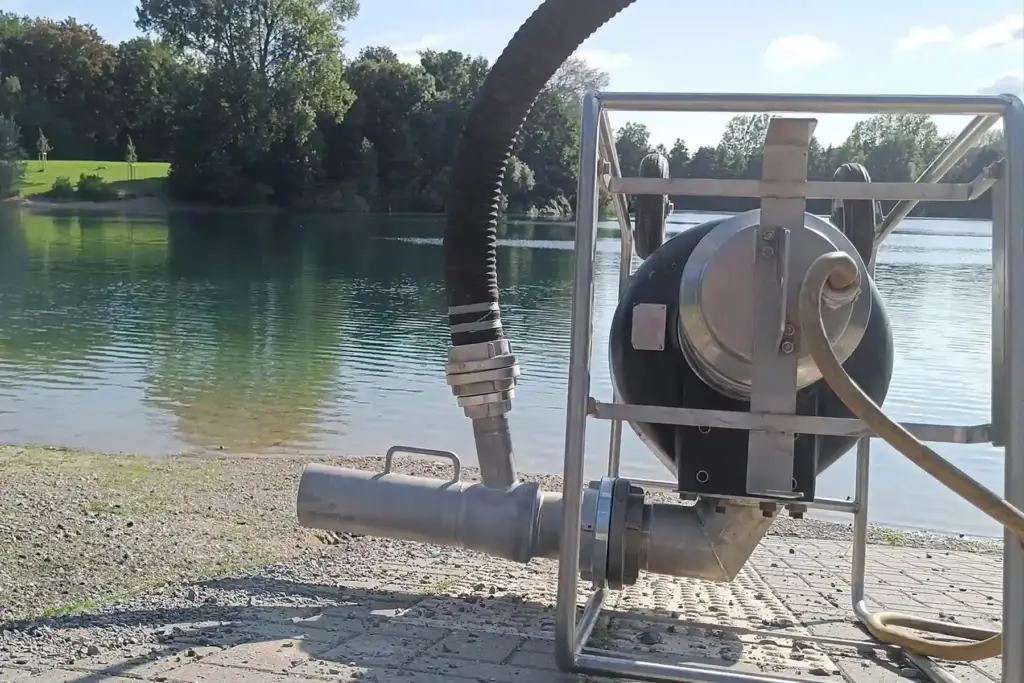
Simply attached to the discharge side of a submersible pump, air is supplied to the pumped liquid via the Venturi effect.

The suction effect is created solely by the flow of the pumped medium, i.e. no additional energy source is required.
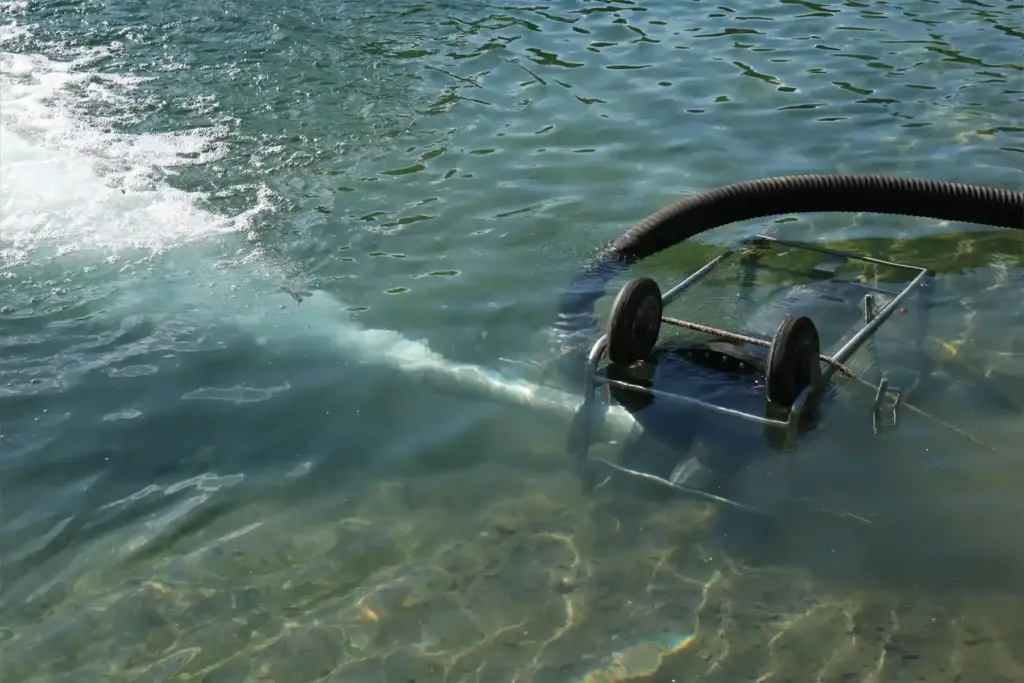
A fine bubble pattern is created, which favors the enrichment of oxygen in the water.
Product presentation (German)
You are currently viewing a placeholder content from YouTube. To access the actual content, click the button below. Please note that doing so will share data with third-party providers.
More InformationYou are currently viewing a placeholder content from YouTube. To access the actual content, click the button below. Please note that doing so will share data with third-party providers.
More InformationBuy VenturiPulse online
You can purchase the VenturiPulse water aerator directly in our online shop.
Air enrichment through the Venturi effect
For healthy waters & biodiversity
The VenturiPulse water aerator can be used to create survival zones in bodies of water by enriching them with air.
- We recommend using at least two water aerators
- The ideal operating depth is between 0.5 and 2 meters
- Over a longer period of use, the entire body of water is enriched with sufficient oxygen
- The water aerator is suitable for near-surface water aeration
- Schnell im Einsatz eignet er sich als Teichbelüfter und Seebelüfter

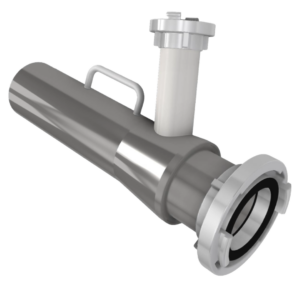
Fast and effective use
Help for eutrophic waters
The water aerator extends the functionality of submersible pumps by directing the pumped liquid sucked in by the pump through the constriction of the aerator. This creates a vacuum and ambient air is sucked in at the second inlet of the water aerator.
The ambient air sucked in mixes with the pumped medium, whereby an oxygen-enriched medium is returned to the water. In this way, eutrophic waters can be treated with sufficient air to prevent species extinction.
Technical data
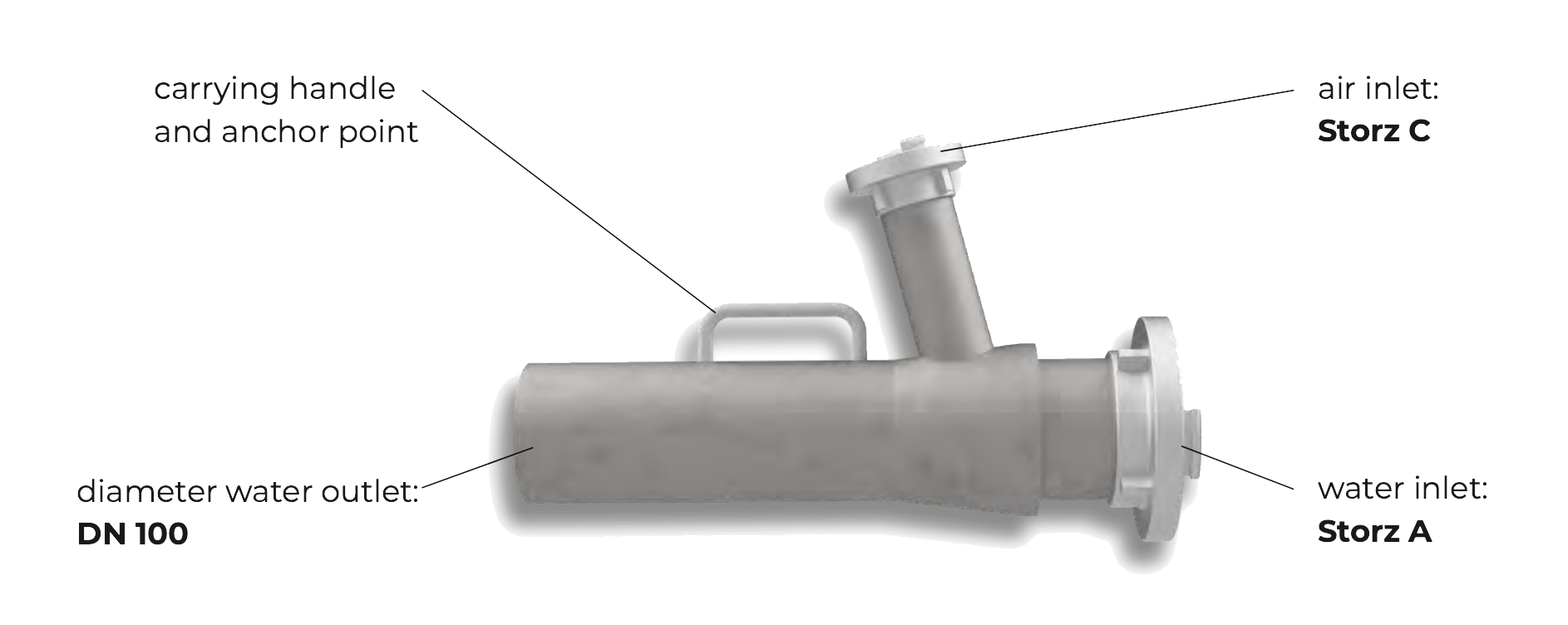
Dimensions
Dimensions (L x W x H)
Weight
Material
Maximum pressure
Recommended water depth
560 x 360 x 190 mm
7 kg
Stainless steel V2A
5 bar
0,5 – 2 m

Brochure (German)
Venturi-Pulse
Compatible with:

Wilo-Drain TP 100E

Chiemsee A & B
With the Wilo-Drain TP 100E, up to 3,400 l/min of ambient air can be supplied using a C suction hose, and up to 4,400 l/min using a B suction hose.
Pumps such as the Chiemsee Type B also work. However, we do not yet have any measured data for these pumps, only feedback from customers based on their practical experience. We therefore recommend always choosing a pump with a flow rate of at least 2,100 l/min.
In practice, however, we have found that the Chiemsee Type B pumps commonly used by fire departments, with a lower flow rate of 1,800 l/min, also work. We are also increasingly receiving feedback that the TP8, with a flow rate of only 1,300 l/min, works as well.
The following accessories are available:
- Suction hose with Storz C coupling on both sides
- Suction hose with Storz B coupling on both sides
- Reducer from Storz A to B
- Reducer from Storz B to C
Do you still have questions? We will give you the answers!
What is meant by tilted or euthanized waters?
Lakes that require remediation are often eutrophic or even hypertrophic, which indicates an excess of nutrients, especially phosphate. This leads to too much biomass forming in the upper layer of water, which consumes oxygen as it decomposes in the lower layer. This can result in the lake becoming oxygen-free at depth, which leads to the death of organisms that require oxygen. Toxic anaerobic decomposition products such as hydrogen sulphide and ammonia can form, and digested sludge develops on the lake bed. The phosphate it contains remains problematic, as it does not form an insoluble compound with trivalent iron and its fertilizing capacity is retained despite mixing, which is known as “tipping over” the lake. The enrichment of oxygen in bodies of water can prevent a body of water from tipping over.
- This is clearly explained in this video: Lake ecosystem – eutrophication
Why is the VenturiPulse suitable for water aeration and what distinguishes the VenturiPulse from conventional application tactics?
The ambient air is introduced directly into the water through the near-surface ventilation. This creates a fine bubble pattern that promotes oxygen enrichment in the water. These bubbles spread over a larger area and create slight waves that raise the surface of the water. This contributes to additional oxygen enrichment. As a result, survival zones for aquatic organisms are initially created in which sufficient oxygen is available. Over time, the oxygen content in the entire body of water increases and the overall water quality improves. Extensive experience in use has shown that this method of water aeration with a supply of up to 4000 l/min of ambient air is significantly more efficient than the suction of water, which is directed through hoses as spray water onto the water surface.
How many VenturiPulses are required for the application?
It is advisable to use at least two water aerators at the same location, which introduce ambient air in different directions in order to enrich zones with ambient air. Water aeration is particularly recommended at times of day when there is no sunlight, as photosynthesis then stops and less oxygen is enriched in the water. Ideally, it should be started before dusk. However, this should be done in close consultation with the relevant authorities or water boards.
How is it ensured when using the VenturiPulse that there is no damage to the water?
The suction side of the pump used should never point towards the bottom so that bottom particles are not sucked in and distributed in the water. This prevents damage. This also ensures that no digested sludge is sucked in. The water aerator is only suitable for near-surface water aeration. The ideal operating depth is between 0.5 and 2 meters. With deep aeration, there is otherwise a risk of harmful substances such as hydrogen sulphide being washed out and stirred up. The water outlet of the water aerator should ideally be parallel to the floor – and should never be directed towards the floor. Otherwise there is a risk of the soil being washed out and sediments being stirred up.
How are pumps secured when used with VenturiPulse in water?
The use of the water aerator creates a recoil on the outlet side of the aerator, which must be absorbed, otherwise the pump and water aerator may make uncontrolled movements. Depending on the ambient conditions, the recoil can be successfully absorbed by the following measures. The first option is to be preferred if possible:
- Use of ground pegs, lantern irons or equivalent functional parts to secure the pump to the ground or to restrict the movement of the pump
- Use in the paved bank area (stones)
- In certain cases, a lattice box or similar container may be suitable for lowering the pump with water aerator
Which pumps is the VenturiPulse compatible with?
The water aerator alone has already been successfully tested with the following pumps:
- Wilo-Drain TP 100E
- Spechtenhauser Pumpen GmbH Model: Chiemsee A
- Spechtenhauser Pumpen GmbH Model: Chiemsee B; with reduction Storz A to B
The VenturiPulse works with all pumps that have the same or better technical data than the Chiemsee B. Pumps with higher specifications than the Wilo-Drain TP 100E must not be used with VenturiPulse. Use is at your own risk. More information can be found in the operating instructions. However, we are always endeavoring to test and safely release further pump models.
Please ask us about the models you require. If there is sufficient demand, we will be happy to test them!
What influence does the choice of pump have on the flow rate of ambient air?
As a rule of thumb, the greater the volume flow, the more ambient air is drawn in. In addition, the pump used must have at least one Storz B coupling. With the Wilo, up to 4000 l/min of ambient air can be supplied with a B suction hose and up to 2400 l/min with a C suction hose.
At what depth can the VenturiPulse be used?
The water aerator is only suitable for near-surface water aeration. The ideal operating depth is between 0.5 and 2 meters. With deep aeration, there is otherwise a risk of harmful substances such as hydrogen sulphide being washed out and stirred up.
Which accessories are required for the VenturiPulse?
- PVC suction hose or equivalent or higher quality suction hose with Storz C coupling on both sides; optionally with strainer on a Storz C coupling to minimize contamination and injuries
- PVC suction hose or equivalent suction hose with Storz B coupling on both sides
- Reducer from Storz A to B
- Reducer from Storz B to C
We will be happy to advise you on which accessories you need for your specific application. You can often use materials that you already have in your office anyway.
Who needs to be involved in water aeration?
It is strongly recommended that the responsible water authorities and/or water boards are involved in every operation and that the procedures are coordinated with each other! You should also find out about any other contacts that should be involved in your region.
Are there examples from practice?
Yes! The VenturiPulse has already been used successfully to prevent water from tipping over. You can find an example of a THW Pfaffenhofen operation here: Water aerated: Fish mortality prevented
Questions? Ideas? Wishes?
If you have any questions about our products or would like to share your own ideas and wishes with us, we look forward to talking to you. Write to us directly at info@inventied.de. We always design our solutions with the practical requirements of emergency services and disaster relief organizations in mind and are open to your suggestions.
Simply fill out our contact form and let us know that you would like a non-binding quote for the VenturiPulse water aerator. Of course, you can also enquire about our other products at the same time.
Share on Social Media